Fastest path
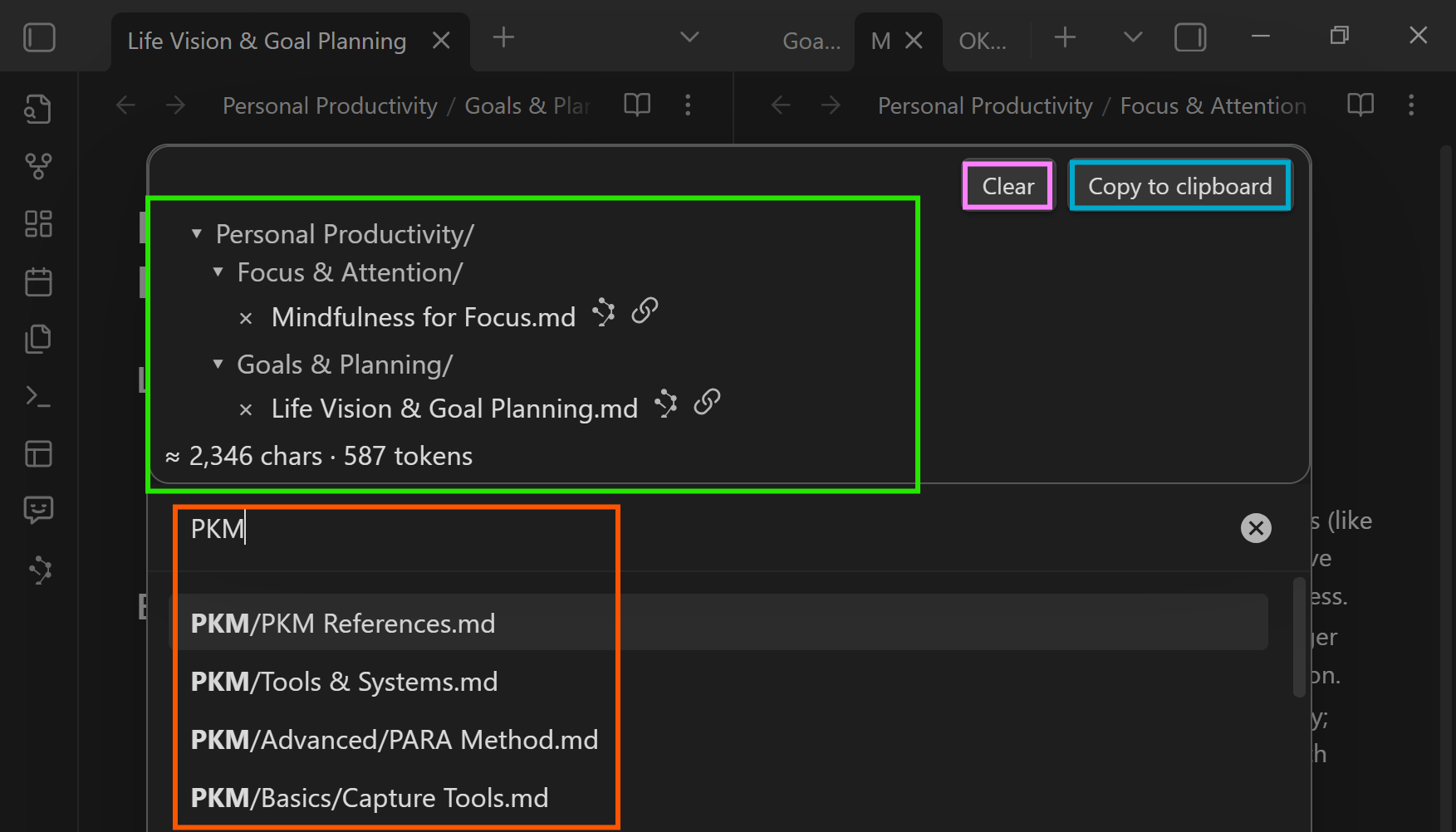
Copy the current note at Depth 0 or 1
Best when one note already anchors the assignment. Use Depth 0 when the note is enough and Depth 1 only when direct links hold ground truth.
Official Smart Plugins site Smart Plugins are independent third-party plugins for Obsidian. Smart Connections is the flagship plugin.
Stop pasting vague prompts. Build grounded context packages from your actual notes, then reuse them across ChatGPT and other AI tools.
Smart Context assembles the package in Obsidian. Content leaves when you paste, export, or send it to another tool. A configured cloud embedding or ranking provider can separately receive eligible source text during Smart Environment processing.
Core: copy notes and folders, choose current-note link depth, save named contexts | Pro: media, external sources, dynamic groups, and Rules
Fastest first win: follow the Getting Started guide and copy one reviewable context bundle today.
Better AI output usually starts before the model. Smart Context helps you copy the right notes in the right shape so the assignment stays grounded and reviewable. Start with the smallest context that makes the assignment understandable.
Fastest path
Best when one note already anchors the assignment. Use Depth 0 when the note is enough and Depth 1 only when direct links hold ground truth.
Selected scope
Best when the scope is already chosen. Copy a small folder, file-nav selection, or short set of notes instead of the whole vault.
Learn: Use file navigator actions to copy notes and folders as context
Repeatable work
Best when you repeat the same work. Save a named context once, then reuse it across chats and projects.
Want outputs that stay consistent? Use templates in Settings so every export has the same structure (headers, metadata, file tree).
Want the shortest reliable loop? Copy a note at Depth 0 or 1, then prompt: "Use only this context. Extract constraints first, then propose next actions."
Use Smart Context when your notes already contain the answer, but your AI replies still drift because the right evidence is not packaged together.
This is where Smart Context pays off: when your notes are right, but your prompts are not. Choose the job that matches your current friction and copy a pack that fixes it.
If every new chat starts with backstory, save a named pack once and reuse it.
Include: brief, constraints, decisions, latest status. Build it in the Builder .
"Using only this context, summarize current state, risks, and the top 5 next actions. Cite the note title for each claim."
If decisions keep getting lost between meetings, export a reliable prep + follow-up bundle.
Include: agenda, last notes, decisions, open tasks. Copy via Clipboard (or save as a named pack).
"Draft a prep brief and follow-ups with owners. Pull action items from the context and keep wording concise."
If your hub note cites the real sources, copy it with Depth 1 so the references come along.
Include: hub note + cited notes. Use Depth 1 to stay grounded.
"Summarize, list open questions, and cite sources by note title. If evidence conflicts, call it out explicitly."
If your writing help keeps drifting, bundle your rules and examples with the draft.
Include: outline, draft, tone rules, 1-3 examples. Standardize output with templates .
"Continue the draft in my voice. Follow the outline. Use only the provided references for claims."
If context keeps exceeding limits, treat depth and blocks as budget controls.
Start at Depth 0. Expand only when needed. Use the size estimate as a budget signal.
"If this is too large, tell me what to remove first (in order) while preserving constraints and ground truth."
If the truth lives in screenshots, diagrams, or PDFs, export visuals alongside text.
Use Copy context with images and PDFs and paste into an image-capable model.
"Use both the text and images. Call out any visual gaps or mismatches with the written notes."
Coders and agents: pin external repos and files inside a note with the Codeblock workflow (Context Pro).
Core includes reviewed note packages, named reuse, and basic Canvas and Bases sources. Choose Context Pro when the task needs media, external files on desktop, dynamic source groups, Rules, or richer Bases rendering.
Core plugin
Build precise bundles of notes and reuse them across prompts and projects.
Pro plugin Advanced context sources
Advanced tools for context engineering: external sources, media-aware exports, and agent-ready outputs.
If your account already shows active Pro access in the Smart Plugins Store, use that access; you do not need another subscription. Check the signed-in account's access status rather than assuming every supporter pledge enables every Pro workflow.
Start simple, then level up to reusable packs, predictable templates, and Pro workflows.
Screenshots + the fastest first-win workflows.
Choose current-note depth, or copy an already-selected set of notes or folders directly.
Save trusted context packs and reopen them instantly.
Standardize wrappers, metadata, and file tree output.
Core manifests can reference notes and named contexts. Pro adds supported external include and exclude paths on desktop.
Copy selected notes, folders, or curated file-nav selections without opening another surface.
Start from the note you are already working in and choose how far links should expand.
Use a visual project map as the starting point for copied AI context.
Include visual ground truth when text alone is not enough.
Turn recurring project context into a reusable working set.
Context supplies the evidence; Templates supplies the repeatable form.
Context Pro, Smart Chat, and more advanced workflows.
Quick answers to the highest-intent pre-install questions about compatibility, privacy, first wins, token budgets, and Pro workflows.
Smart Context helps you build grounded context packages from your actual Obsidian notes, then reuse them across ChatGPT and other AI tools. It reduces vague prompts by helping you copy the right notes in a clean, repeatable format.
Yes. Smart Context is clipboard-based, so you can paste exported context into ChatGPT, Claude, Gemini, Smart Chat, or another AI tool. The same context bundle can be reused anywhere that accepts pasted text.
Smart Context assembles the package in Obsidian. Content leaves when you paste, export, or send it to another tool. A configured cloud embedding or ranking provider can separately receive eligible source text during Smart Environment processing. Review providers and data boundaries in Smart Environment settings and the Privacy Policy.
Copy the current note with Depth 0 or 1, then paste it into the AI tool or Smart Chat thread you already use. You know it worked when the copied bundle is small enough to inspect and includes the context the assignment needs.
Use the current note when one note anchors the task, a folder when the project already lives together, and a reusable pack when you need a curated working set you will reopen across sessions.
Depth 0 copies the starting note. Depth 1 adds directly linked notes. Depth 2 adds links of links, and deeper levels expand further. Start small and expand only when the extra evidence is needed. See Clipboard + depth.
Start at Depth 0, expand only when needed, and use the size estimate as a budget signal. If one note is too large, switch to a smaller selection or a curated pack instead of copying the entire folder.
Yes, in Core and Pro. The Builder lets you create, name, reopen, and reuse reviewed context sets across tasks. Recheck source availability and size before reuse; in Pro, check Rules too.
Yes. Settings lets you customize context templates, item templates, wrappers, file paths, and file tree output so exports stay stable across workflows.
Core covers note and section selection, current-note link depth, direct folder copy, named contexts, codeblocks, template-driven exports, and basic Canvas and Bases sources. Context Pro adds media and ZIP outputs, external files on desktop, dynamic groups, Rules, heading filters, and richer Bases rendering.
Yes, with Context Pro. Copy media creates a composite image from supported images and PDF pages. Run Copy text separately when the task also needs written sources. The Codeblock workflow can include supported external repos or files on desktop.
Yes. You can send results from the Connections view to Smart Context, remove noise, and copy the curated pack. See the Connections view guide.
Build your first context pack now and watch your prompts level up. Start with the free Core plugin, then add Context Pro when you need media, external sources, and agent-ready bundles.
Smart Project lessons
Begin with a four-part introduction, followed by selected lessons from the systems, tools, and workflows behind Smart Plugins.
Subscribe to the Smart Project lessons and selected updates. Unsubscribe anytime. Privacy policy.